Building Impact: A Closer Look at Local Cross-Sector Collaborations for Education
Published:
01/2020
... from the difficulty posed by school districts that view collaboration as a distraction, to the expense of setting up ...

Search Tip: Search with " " to find exact matches.
The Democracy Collaborative’s report Anchor Collaboratives: Building Bridges with Place-Based Partnerships and Anchor Institutions discusses the role of anchor institutions and collaboratives in leveraging the power of their economic assets to address social and economic disparities and to revitalize local communities.

This new comprehensive research primer from Aspen Institute EPIC draws on extensive review of the research literature, engagement with more than 100 experts, and analysis of federal survey data.
This report by the Funders’ Network for Smart Growth and Livable Communities examines the potential of anchor institutions hold to create lasting and sustainable change—and illustrates how funders are working with anchor institutions to create healthier, more equitable, and economically vibrant places to live and work.
The report is an in-depth baseline needs assessment of women in Montgomery County, PA and explores eight major areas affecting the lives of women: employment and earnings; work and family; poverty and opportunity; health and well-being; reproductive rights and infant health; violence and safety; political participation; and women veterans.
Developed in partnership with United Philanthropy Forum and Northern California Grantmakers, this guide shares seven practices and 12 tools for Philanthropy-Serving Organizations who seek effective ways to mobilize resources to sustain their organization’s work.

ABFE: A Philanthropic Partnership for Black Communities (ABFE), recently conducted a study to learn how leaders of Black-led social change organizations in the United States and U.S. Territories describe their interactions with institutional philanthropy.
In 2020, ProFellow, the leading online resource for information on professional and academic fellowships,partnered with IREX to produce the 2020 Fellowship Industry Report.
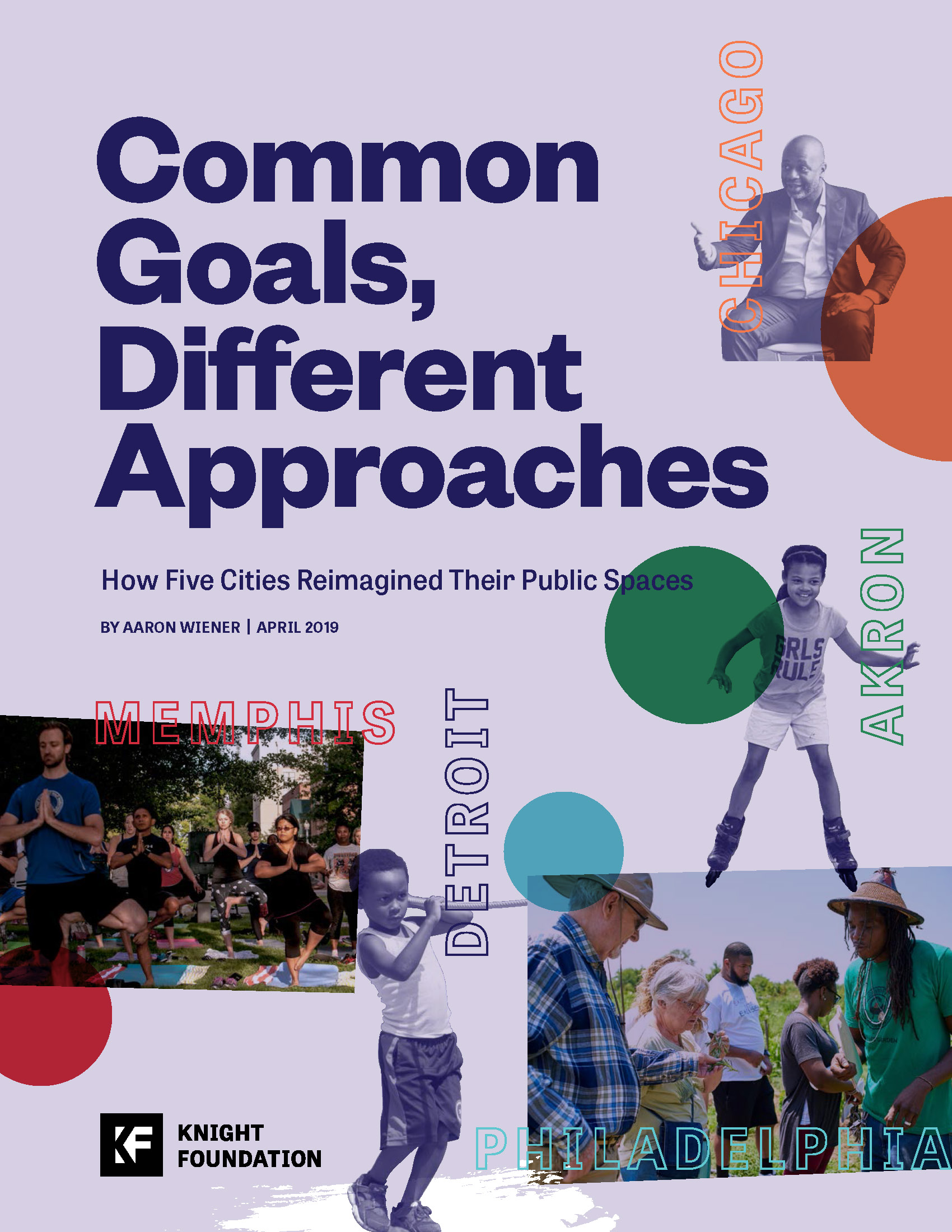
A new report from JOHN S. AND JAMES L. KNIGHT FOUNDATION showcases how Philadelphia and four other cities have reimagined their public spaces as part of a national initiative called Reimagining the Civic Commons.
In Deciding Together: Shifting Power and Resources Through Participatory Grantmaking, we look at why and how funders are engaging in participatory grantmaking and shifting decision-making power to the very communities impacted by funding decisions. Through examples and insights from a diverse range of participatory grantmakers, we explore the benefits, challenges, and models of participatory grantmaking.
An increasing number of foundations are embracing racial equity/equity as a core value, and it is influencing how they see themselves and operate. However, evaluation has for the most part remained untouched. Knowing how race/racism has influenced both, philanthropy and evaluation, deepens our understanding of how philanthropic evaluation practice may unintentionally reinforce racism. Equitable evaluation shifts the current evaluation paradigm to one that centers equity/racial equity, so that it is more aligned with the values and intentions of current day philanthropic endeavors.
New research shows that Black fund managers must overcome racial bias to win institutional money and are judged more harshly as top performers.
Results of an online experiment suggest that underrepresentation of people of color in the realm of investing is not only a pipeline problem, and that funds led by people of color might paradoxically face the most barriers to advancement after they have established themselves as strong performers.

For a decade, Knight Foundation has been intentional about identifying high quality, diversely-owned asset managers when investing its endowment. In response to frequent questions from a variety of stakeholders into the performance of the charitable sector regarding this issue — the questions arising from the general lack of data — Knight Foundation asked Global Economics Group to assess the representation of diverse asset managers among foundations.
Out of concern for immigrant rights, especially the health and well-being of our immigrant children, Philanthropy Network members authored this open letter calling on Governor Wolf and the Department of Human Services to close the Berks County Residential Center (BCRC), one of three immigrant fam